AI Dashcams for Fleets: Motive vs Samsara vs Netradyne
Reader-supported, no affiliate links (yet): No affiliate links in this article — and none of the three dashcam vendors below runs a public self-serve affiliate program, so there’s nothing to sign up for. (Motive runs an insurance-agency referral program — different thing.) We’ve applied to affiliate programs elsewhere (FreshBooks, QuickBooks, Truckstop via PartnerStack), approvals still pending, but nobody paid for a ranking here, and nobody could. Pricing verified as quote-only on September 29, 2026 — none of the three publishes a price on its official pages, and third-party estimates are guesses, not facts. They change, so confirm on the vendor’s site before buying.
Looking for the best AI dashcam for fleets? Here’s the first thing to know: none of the three serious AI dashcams in this roundup publishes a price. Netradyne, Motive, and Samsara are all quote-only — demo-gated sales, no public tiers, no trial you can start today. So this article can’t be won on price. It’s won on the AI architecture (edge vs. cloud), the quality of the coaching that follows the footage, and who the driver-facing camera answers to.
The stakes: large trucks were involved in 168,118 crashes in 2024, with 74,314 injuries and 4,868 fatalities — about 12% of all US motor-vehicle fatalities (FleetOwner’s “Trucking By the Numbers 2025,” January 2026, citing FMCSA data). Crash totals have been edging down about 3% a year since 2021 — improving slowly, not solved.
Here’s the honest thesis: Netradyne sells the camera, Motive sells the trucking platform the camera lives in, and Samsara sells the operations platform the camera reports to. The buyer’s real decision is which of those three things they want. And since no vendor publishes a number, the table below has no price column to shop — every price cell reads “Quote-only,” and there’s a reason for that, not a lack of research.
The companion piece to this one is on the shop side: AI fleet maintenance software. Maintenance keeps the truck legal; dashcams keep the driver safe — the two halves of the same safety equation.
Quick picks
- Best AI dashcam for a safety-first fleet: Netradyne Driveri (D-450) — the only camera-first AI in the roundup, quote-only. The default pick, on AI capability.
- Best for fleets already in the Motive ecosystem: Motive AI Dashcam — quote-only. Obvious if your trucks already run Motive ELDs.
- Best safety ecosystem (20+ vehicles): Samsara CM34 — quote-only. Priced and packaged for mid-size and up.
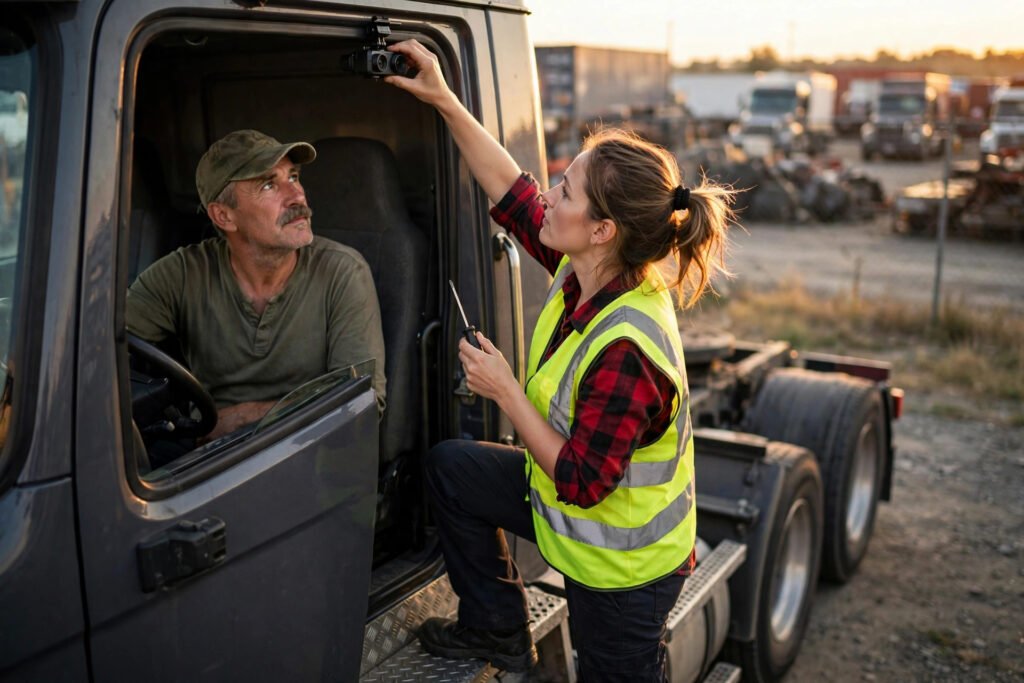
1. Netradyne Driveri — the best AI dashcam for a safety-first fleet (the pick)
Best for: A fleet buying a dashcam for the AI, not for the platform it lives in. Price: Quote-only. No pricing anywhere on netradyne.com — the official call-to-action is “Book a demo.” I couldn’t find even a third-party price estimate to hedge against, so there is no number to budget off. That’s the least small-fleet-friendly sales motion of the three, and I won’t sugarcoat it.
Driveri is the only tool in this roundup whose core product IS the AI dashcam — not a dashcam bolted onto a telematics platform. The current flagship is the D-450, a four-camera AI video safety platform. The D-215 is the older dual-camera model (previous generation); Netradyne’s current marketing centers the D-450, and an 8-camera “360 AI” platform, the D-810, was announced in January 2026 — but general availability hasn’t been confirmed, so treat it as announced, not available.
The AI (real, named): Driveri with edge computing — Netradyne says the AI runs on-device, so alerts fire without a cloud connection, and it “records and analyses 100% of driving time,” not just triggered events (the vendor’s wording). That architecture is the genuinely differentiating thing here: competitors record continuously but analyze events; Netradyne claims to analyze everything, which is why its alert volume and coaching data run richer. The GreenZone driver scoring dashboard is “the industry’s first to provide a comprehensive score of both safe and risky driving behaviors” — the only scorecard in this roundup that systematically rewards good driving, and that matters enormously for driver buy-in on the driver-facing camera. It changes the conversation from punishment to recognition. The optional DMS Sensor adds drowsiness detection using PERCLOS (percentage of eyelid closure), and trade press reports it works in low light and with sunglasses. Netradyne’s own numbers: “over 25 billion miles analyzed” and “up to 99% alert accuracy*” — vendor claims, and the asterisk has no visible footnote on the page, so keep the salt shaker handy.
Useful vs. fluff: the edge architecture and 100%-of-drive-time analysis are real product differences. The positive-reinforcement scoring is a real product difference too, not marketing garnish. The “99% accuracy” claim gets the same treatment as everyone else’s — an asterisked vendor number.
What it does for a trucker: Netradyne has no ELD, no telematics, no GPS platform of its own — Driveri sits alongside (or integrates with) whatever you already run. Trade coverage names integrations with PCS TMS, Platform Science, RTA Fleet Management, and Trimble TMS. Long-haul trucking is explicitly called out as a target sector for the drowsiness detection. Expect two bills unless your stack already includes something it integrates with.
Driver-facing camera policy: the D-210 hardware manual states the driver/passenger-facing camera is “optional, activated at customer request due to privacy considerations,” with device LEDs indicating the recording/privacy status. That’s third-party-hosted manual wording, not a current US privacy page — Netradyne’s current US privacy posture couldn’t be independently verified — but it’s the most driver-friendly official privacy posture of the three.
Weak spots: quote-only with zero public price signal; no native ELD/telematics (two-bill reality); user reviews flag inaccurate speed-violation alerts needing manual cleanup, no bulk alert dismissal, and slow back-end support past the front-line success managers (third-party reporting); smaller company than the other two — diligence warranted. No trial found.
Verdict: the pick. If safety coaching is the reason you’re buying a dashcam, buy the one whose whole company exists to make the dashcam. If you want one platform for ELD + safety + maintenance, that’s Motive’s lane, not Netradyne’s.
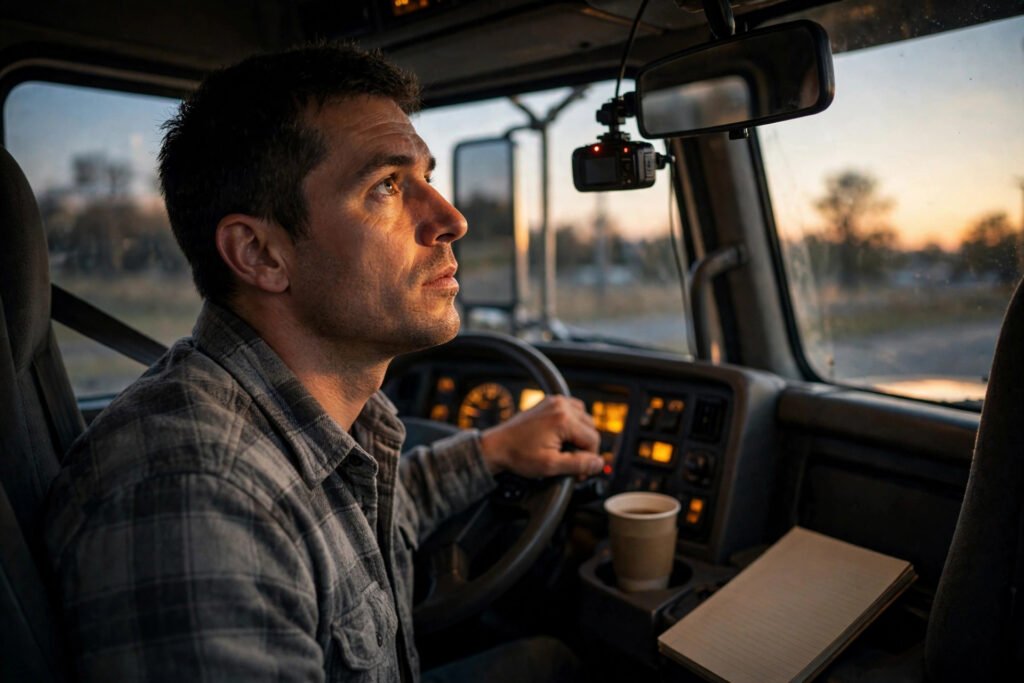
2. Motive AI Dashcam — best for fleets already in the Motive ecosystem
Best for: Fleets whose trucks already run Motive ELDs, dashcams, or the Motive Card. Price: Quote-only. No published pricing anywhere on gomotive.com — the product page ends in “get started today” plus a sales phone number. No pricing tiers exist to list.
Motive sells the platform, not the dashcam. The AI Dashcam is hardware inside the broader Motive stack (ELD, telematics, Motive Card, and now Motive Maintenance). The hardware lineup: the Dual-Facing AI Dashcam (DC-54), Road-Facing AI Dashcam (DC-53), Smart Dashcam dual and road variants (DC-34/DC-33), AI Dashcam Plus (DC-63/64), and the AI Omnicam 360° add-on (1080p, IP69K, pairs with the AI Dashcam) — all on Motive’s own help center. Value compounds for fleets already running Motive ELDs; as a cold dashcam-only buy, it competes with two specialists at unknown pricing.
The AI (real, named): Motive’s AI detection models “recognize unsafe driving actions instantly,” with real-time in-cab audio and visual alerts; Motive says the system detects 20+ safety events at “up to 99% accuracy” (vendor claim). AI Fatigue Detection launched in May 2026: six escalating indicators — face rubbing, stretching, eye rubbing, yawning, lane swerving, microsleep — and Motive says it’s “fully enabled on existing Motive AI dash cams, no additional hardware required” (vendor claim), with real-time in-cab alerts announced as coming “soon.” AI Eating Detection is the most careful false-positive design I’ve seen in this category: it only fires when food is visible, speed is over 25 mph, the event lasts 5+ seconds, and you’re not drinking. Motive’s in-house safety team “analyzes every video within seconds” and auto-coaches drivers post-trip via the Driver App.
Useful vs. fluff: the in-cab alerts plus post-trip auto-coaching is a complete feedback loop — detect, alert, review, coach — and it’s the most trucking-integrated of the three. The eating-detection gating shows real false-positive engineering, which is the thing that actually determines whether drivers trust the system. One trust dent worth mentioning briefly: Motive’s own product page carries a court-ordered disclaimer — an arbitrator ruled Motive’s benchmark claims that its AI dashcam was “three-to-four times more successful, accurate and speedy in detecting unsafe driving than Samsara’s” to be literally false in violation of the Lanham Act (an ITC case separately cleared Motive of Samsara’s patent-infringement claims). The hardware is fine; the accuracy marketing deserved the skepticism. Take every accuracy percentage in this category — from every vendor — accordingly.
What it does for a trucker: this is the most trucking-native of the three. FMCSA-registered ELD, IFTA reporting, Smart Load Board, DVIRs, and the Driver App where auto-coaching lands. Fault codes and HOS data flow from Motive’s own hardware into the same dashboard as the video. Availability is US and Canada (trade-press reported). (Dispatch software finds the freight; Motive’s dashcam protects the driver hauling it.)
Driver-facing camera policy: Driver Privacy Mode disables the driver-facing camera entirely, and the camera can be set to run during working hours only — verifiable controls on the official product page. Live streaming is opt-in (admin-enabled), and drivers get audio and visual alerts when a stream starts or ends — alerts Motive says can’t be turned off. That’s the concrete answer to the privacy objection.
Weak spots: quote-only pricing; the Lanham Act ruling above; third-party sources report 12-month minimum contracts as the industry norm (unverified — do not assert terms); user reviews recurringly flag ELD log-edit friction and setup-tablet connectivity (third-party reporting). No trial found.
Verdict: if your trucks already run Motive ELDs, this is the obvious dashcam — same dashboard, same app, same driver relationship. As a cold buy against Netradyne’s camera-first AI, the accuracy-marketing trust dent and quote-only pricing make it the second choice.

3. Samsara CM34 — the best safety ecosystem (20+ vehicles)
Best for: Mid-size operations standardizing on one connected platform. Price: Quote-only. No published pricing on samsara.com — the product page ends in “Talk to sales.” No pricing tiers exist to list.
You buy the Connected Operations platform, not a dashcam: telematics, ELD, safety, and now Connected Maintenance in one contract. The CM34 is the dual-facing AI dash cam; the CM33 is the front-facing AI dash cam (the cheaper single-camera option — Samsara’s own Safety Report says dual-facing is more than 2x as effective as front-facing, which directly justifies the dual-facing recommendation). The CM32 is the previous generation and superseded. Under ~20 vehicles this is overkill and over-budget; the dashcam’s value compounds inside the Samsara hardware stack.
The AI (real, named): Safety Scores — and note the formula is published on the official product page: Harsh Events + Speeding Events + AI-detected unsafe driving events over time. Not a black box. In-Cab Voice Coaching gives real-time spoken feedback; Manager-Led Coaching runs video review workflows with built-in scripts; Virtual Coach lets drivers self-coach; the Safety Inbox auto-tags incidents for review. The detection suite, all on the official page: Forward Collision Warning, Mobile Usage, No Seat Belt, Speeding Detection (10/15/25 mph bands), Rolling Stop Detection, Drowsiness Detection, Lane Departure Warning, and Camera Obstruction detection. Live streaming, Parking Mode (1–12 hours post-trip), and driver assignment via Driver ID Token, Camera ID, or QR code. An AI Multicam setup (up to four HD cameras, 360° visibility) and two-way voice through the dash cam were announced in June 2026 — announced, not confirmed shipping, so check before counting on it.
Useful vs. fluff: the coaching layer is the most mature in this category — built-in scripts, self-coaching, and a published score formula beat a black-box number. Samsara’s first Safety Report (October 2025, vendor-published) is the best-sourced ROI number any vendor in this roundup offers: 2,600+ fleets over 30 months, and fleets running the full AI safety solution — dual-facing AI dash cams, in-cab alerts, AI coaching — saw roughly 75% aggregate crash-rate reduction, versus 35–40% for Samsara customers generally. Keep the attribution attached — it’s Samsara’s own data, not independent research — but it’s a real differentiator. Vendor data also reports 48% fewer harsh events and 84% less mobile usage in the first six months, and a 43% improvement in CSA Unsafe Driving score for 175+ vehicle fleets.
What it does for a trucker: ELD compliance, DVIRs, HOS, CSA score tracking — the full connected-operations picture in one contract. The load pays for the truck; the dashcam defends the claim when something goes wrong — and the load itself comes from the boards.
Driver-facing camera policy: identity blurring — driver and passenger faces, pedestrian faces, and license plates blurred from uploaded and saved video (official, dual-facing only). Plus physical Dual Lens Cover and Driver-Facing Lens Cover accessories sold on the product page. The most technically thorough privacy answer of the three — blurring plus a physical cover.
Weak spots: quote-only enterprise pricing — the highest-friction buy of the three for a small fleet; you need the Samsara Vehicle Gateway and hardware stack for the full feature set; the platform’s breadth means you’re paying for an ecosystem when you asked for a dashcam. No trial found.
Verdict: the deepest safety bench — best coaching workflows, best published ROI data, best privacy engineering. Right for a 20+ vehicle operation; a 5-truck fleet will drown in the platform before it sees the value.
AI dashcams for fleets compared
| Tool | Price | AI architecture | What the AI actually does | Coaching | Best for |
|---|---|---|---|---|---|
| Netradyne Driveri (D-450) | Quote-only | Edge computing on-device — vendor says it analyzes 100% of driving time, no cloud needed for alerts | Instant in-cab alerts; GreenZone scores safe AND risky driving; optional DMS drowsiness sensor (PERCLOS, per trade press) | Positive-reinforcement scoring; manager review workflows | Safety-first fleets buying the best camera |
| Motive AI Dashcam | Quote-only | Cloud-assisted; edge AI launched May 2026 (vendor announcement) | Detects 20+ safety events (vendor claim, “up to 99% accuracy*”); real-time in-cab alerts; fatigue detection (6 indicators); eating detection (5-sec / 25-mph / visible-food gate) | Auto-coaching via Driver App; in-house video review team | Fleets already running Motive ELDs |
| Samsara CM34 | Quote-only | Cloud platform; AI Multicam 360 announced June 2026 (shipping unconfirmed) | Forward collision warning, mobile usage, no seatbelt, speeding bands, rolling stops, drowsiness, lane departure; published Safety Score formula | In-cab voice coaching; manager-led coaching with scripts; Virtual Coach self-coaching; Safety Inbox | 20+ vehicle operations standardizing safety |
All three are quote-only — none publishes pricing on its official pages, and third-party estimates are guesses, not facts. “Up to 99% accuracy” claims are vendor-asserted; treat the asterisks accordingly.
How to pick
- Accept the pricing reality before you shop. Every tool here is quote-only, demo-gated, with no trial. The sale is a conversation, not a checkout page. Anyone who hands you a per-truck number from a comparison site is handing you a guess — don’t budget off it.
- Decide what you’re actually buying. Netradyne sells the camera. Motive sells the trucking platform the camera lives in. Samsara sells the operations platform the camera reports to. A safety-first fleet buys Netradyne; a Motive-ELD fleet buys Motive; a 20+ vehicle operation standardizing everything buys Samsara.
- Match the tool to your fleet size, not the feature list. Five trucks on Motive ELDs: Motive dashcam. Five trucks buying safety-first: Netradyne. Twenty-plus vehicles: Samsara territory. One truck as an owner-operator: none of these — all three are fleet-quoted, and the honest answer is a consumer dashcam or your fleet’s existing program, not a per-month fiction.
- Ask where the AI runs. Edge computing on the device (Netradyne) means alerts fire without connectivity and the vendor can claim analysis of 100% of drive time. Cloud analysis of triggered events is fine, but it’s a different architecture — ask which one you’re being quoted.
- Translate the accuracy marketing before you believe it. Every vendor in this orbit uses “up to 99% accuracy” with an asterisk nobody can inspect — and Motive’s accuracy marketing against Samsara was literally litigated as false (the ruling sits on Motive’s own product page). Ask: 99% of what, measured by whom, on what roads?
- Resolve the driver-facing camera question before you buy, not after. Motive gives you Driver Privacy Mode and working-hours-only. Samsara gives you identity blurring plus a physical lens cover. Netradyne makes the driver-facing camera optional at the customer’s request. Get driver buy-in on paper before the install — GreenZone-style positive scoring helps.
- Don’t forget the second bill. Netradyne is a camera specialist with no ELD or telematics of its own — budget your existing stack alongside it. Motive and Samsara bundle the platform, which is part of what you’re paying for.
FAQ
Will a dashcam actually cut crashes? The best-sourced vendor number in this category is Samsara’s: its October 2025 Safety Report (2,600+ fleets, 30 months) says fleets running the full AI safety solution — dual-facing cams, in-cab alerts, AI coaching — saw roughly 75% crash-rate reduction versus 35–40% for Samsara customers generally. That’s the vendor’s own data, attributed as such — but the direction is consistent with the stakes: 168,118 large-truck crashes in 2024 per FMCSA data. Dual-facing is more than 2x as effective as front-facing alone, per the same report — which is why every pick here is dual-facing.
Why isn’t Lytx DriveCam ranked? It’s the category’s enterprise incumbent — its AI/machine vision identifies 60+ risky behaviors — but it’s quote-only (“Custom Quote” across comparison sites), and users report long-term contract obligations as a sticking point. It sits above the small-fleet price band this article serves. Worth a quote at 50+ vehicles; not the head-to-head here.
What about Verizon Connect or a $100 dashcam from Amazon? Verizon Connect’s Integrated Video is a module inside the Reveal telematics platform, not a standalone AI dashcam product — and it’s not trucking-first. A $100 consumer dashcam (Vantrue, Rove, and the rest) records; it doesn’t coach. No cloud AI, no driver scoring, no coaching workflows, no ELD integration. Fine for an owner-operator’s own liability record; not a fleet safety program.
What’s the AUTOsist camera option I keep seeing? AUTOsist sells a safety-cameras bundle at $55/vehicle/mo alongside its maintenance tracker — cameras next to your maintenance records, not an AI safety program. No named AI dashcam features are verified on its pages. If you want cameras in one dashboard with your work orders, it’s cheap and honest; if you want AI safety coaching, it’s the wrong product.
Can an owner-operator with one truck buy any of these? Not really — all three are quote-only fleet sales with no public pricing and no self-serve tier. The honest answer for a one-truck operation is a consumer dashcam for your own liability protection, or whatever safety program your fleet already runs. Don’t let a sales rep turn a one-truck need into an enterprise quote.
Do these cameras predict collisions? None of them predicts the crash — they detect the behavior that precedes it: phone in hand, following distance, lane drift, eyelids closing. Keep the language at “detect,” because that’s what the AI does. Anyone selling you a camera that “predicts collisions” is selling you a press release.
Bottom line
Buy Netradyne Driveri (D-450) — the default pick, chosen on AI capability, not price (there is no price; it’s quote-only, like the other two). It’s the only camera-first AI in this roundup: edge computing, analysis of 100% of drive time per the vendor, and the only scorecard that rewards good driving as well as flagging bad. If your trucks already run Motive ELDs, the Motive AI Dashcam is the obvious add-on instead — same dashboard, same app. If you’re standardizing safety across 20+ vehicles inside a full operations platform, that’s Samsara’s CM34. Everyone else: don’t buy a dashcam for the press release. Buy it for the AI architecture, the coaching, and the answer on the driver-facing camera.
[…] Driver App shows your DRIVE risk score, benchmarked against Motive’s whole vehicle network. (Full dashcam breakdown here; maintenance AI breakdown […]