Reader-supported: no affiliate links active yet — our rankings can't be bought. How we rank →
Crosswinds in an Empty Trailer: Slow Down or Park It

On this page
You are deadheading in an empty dry van, and the gusts have started moving the trailer for you. Honest starting point: there is no single federal wind number that tells you when to park. What exists is a susceptible rig, handling rules, numbers that each belong to one system — and a control test.
The worst rig in this wind
Strong winds make it difficult to stay in your lane, and the problem is usually worse for lighter vehicles (Georgia CDL Manual §2.7.3). WYDOT says why: box-shaped or van-type trailers, with large vertical surface area, are more susceptible to blowing over, and enclosed trailers — 53-foot box trailers and doubles — are the most susceptible. Empty or light, in a box, you are that rig.
Slow down, stay centered, steer gently
Stay centered and don’t drive alongside others if you can avoid it — the problem can be especially bad coming out of tunnels (§2.7.3). Georgia DDS names the other gust spots: buffeting occurs on bridges, through mountain passes and ravines, and when being passed. Reduce speed, check traffic, and be prepared to steer windward. Steer gently and smoothly: a sudden steering movement could tip your trailer over (§6.1.2).
The numbers — and whose they are
On Wyoming’s road reports, WYDOT defines Strong Wind as gusts of 40 mph, and issues an Extreme Blow Over Risk warning at gusts of 60 mph or more where a closure to light, high-profile vehicles cannot be signed — aimed at lightly loaded commercial vehicles among others. Wyoming also closes segments by gross vehicle weight: there, the weight on the sign binds you. Virginia’s bridge rule: on its named river bridges, an advisory is posted at sustained 30 mph over 30 minutes or frequent gusts of 45 mph or more — high-profile vehicles should not cross, trucks with small or empty loads are especially at risk — and a closure notice at sustained 45 mph or above over 15 minutes, on bridges not physically barricaded. Those figures belong to those bridges. A Wind Advisory or High Wind Warning likewise carries the issuing office’s figures: offices set their own criteria, and they vary.
When to park it
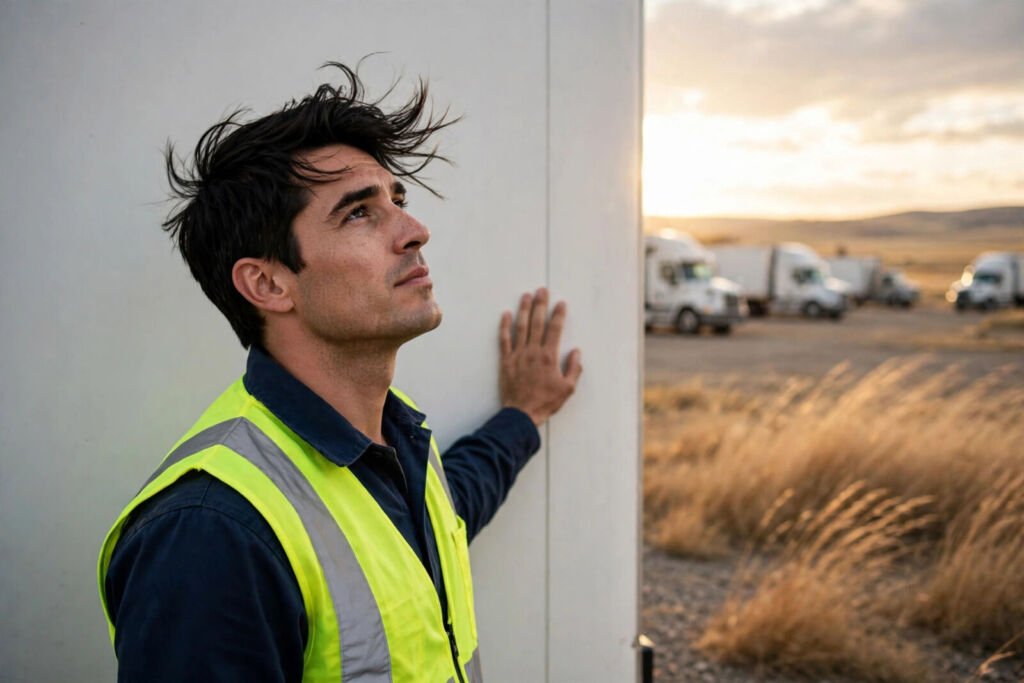
WYDOT’s rule, and this tip’s: if strong winds make it hard to keep control of your vehicle, regardless of weight or shape, pull over somewhere safe — a rest area, parking area, or town — and wait for winds to subside. The federal backdrop backs the call: §392.14 requires extreme caution, reduced speed, and discontinuing operation if conditions become sufficiently dangerous — but its text lists snow, ice, sleet, fog, mist, rain, dust and smoke, not wind, and sets no mph figure. FMCSA guidance puts the decision on the driver. General information only — not legal advice.
Quick checklist
- Before you roll: check the forecast, alerts and DOT / 511 restrictions — and know if you are the susceptible rig: empty or light, enclosed box.
- Slow down, stay centered, and don’t drive alongside others if you can avoid it.
- Expect the gust: worst coming out of tunnels, and as buffeting on bridges, through passes and when passed. Steer gently; be ready to steer windward.
- Read every number in its own system: a posted weight-based closure naming your GVW is a restriction, not advice; bridge and alert figures belong to that bridge, that office.
- Park it: if the wind makes the rig hard to control, whatever its weight, get to a rest area, parking area or town and wait.
- The stop call is yours: FMCSA guidance on §392.14 puts the decision to cease operation on the driver.
- Independent testing
- No sponsored rankings
- Prices verified November 2026