
Reader-supported: no affiliate links active yet — our rankings can't be bought. How we rank →
Best Truck GPS for Truckers in 2026
Garmin's dēzl OTR has the deepest truck-restriction database, no subscription, and free map updates.
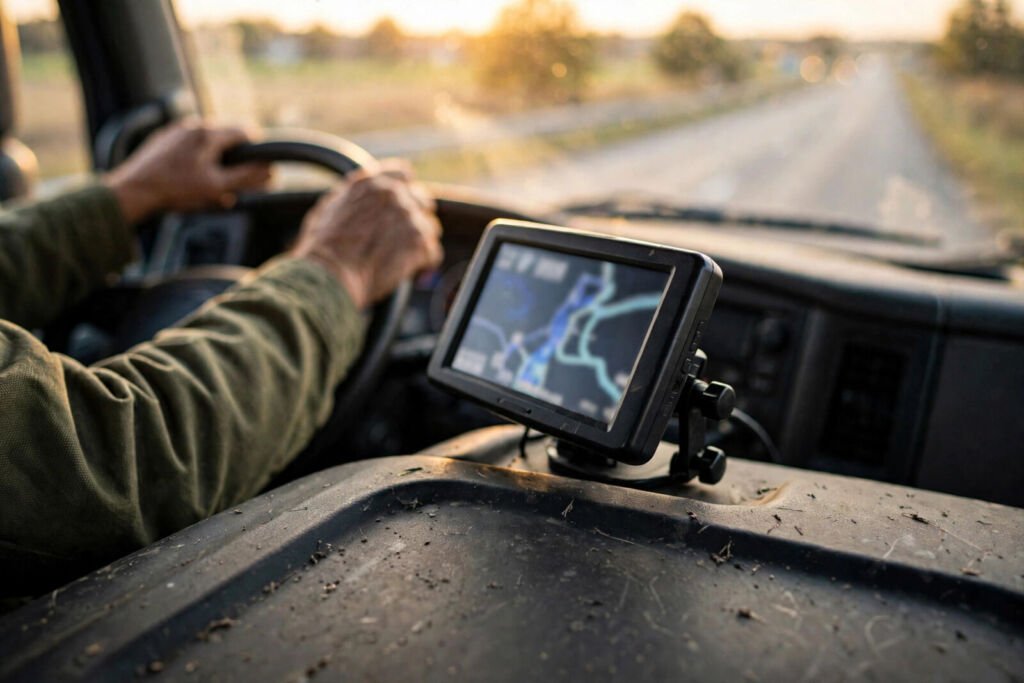
Comparison matrix
| Product | Price / terms | The short version |
|---|---|---|
| Garmin dēzl OTR series (our pick) | $349.99–$899.99 (suggested retail range across the OTR series; total annual software cost $0) | Drivers who want a dedicated truck GPS |
| Rand McNally TND 750 | $399.99 | the value hardware pick at $399.99 with free lifetime map upgrades; but the $399.99 is launch-era retail (street prices move around it), the big-screen TND Tablet 1050 is roughly double (~$799.99), and like Garmin it advertises no dedicated HazMat routing. |
| SmartTruckRoute | $59/year | the budget play at $59/year (about $4.92/month, computed), the cheapest honest truck routing with daily map updates; but it lives on the phone (a dead phone mid-route is a dead GPS), wants a data connection, and the product line appears to be in transition — check which version is current before subscribing. |
On this page
Model update — October 9, 2026: this comparison contains older OTR610/710/810/1010 specifications and historical prices. Garmin also documents newer OTR820/OTR1020 models in its official owner’s manual. Confirm the exact model, current price, availability, and features before buying. We removed the claim that the 2022 lineup is the complete current range; this is not a hands-on review of the newer models.
Reader-supported, no affiliate links (yet): No affiliate links in this article — Garmin, Rand McNally, and TeleType (SmartTruckRoute) have no public affiliate relationship with us that we could verify. We have applied to affiliate programs elsewhere (Truckstop via PartnerStack, FreshBooks, QuickBooks, Upper Route Planner), approvals still pending, but nobody paid for a ranking here and nobody could. Every price below was re-verified September 29, 2026 — prices change, so confirm on the vendor’s site before buying.
Shopping for the best truck GPS for truckers in 2026 comes down to one question: does it know your truck? A car GPS will happily route a 13’6″ trailer under an 11’8″ bridge and call it the fastest route. A truck GPS earns its money on the opposite skill — knowing bridge clearances, weight restrictions, and truck-prohibited roads before you commit to a turn. This article ranks the in-cab options that do that job: two dedicated hardware units and one phone app, all with verified list prices and no invented numbers.
One scope note: this is the in-cab navigation guide — the screen on your dash. Planning optimized multi-stop routes for dispatch is a different job, and we covered it separately in our route optimization software comparison. If you need both, buy the planner for the office and the GPS for the cab.
Quick picks
- Best overall: Garmin dēzl OTR series — 6″, 7″, 8″, and 10″ models with suggested retail prices from $349.99 to $899.99. Custom truck routing by rig size and weight, included map updates, no subscription. The 7-inch OTR710 is the sweet spot. (Garmin’s official launch pricing, Sept 2026 check.)
- Best value hardware: Rand McNally TND 750 — 7-inch, $399.99 retail, free lifetime map upgrades, live traffic, fuel prices, and weather. The long-running workhorse of truck stops. (Vendor-stated retail, Sept 2026 check.)
- Best app / budget play: SmartTruckRoute — $59/year (about $4.92/mo, computed) in-app subscription, maps and routing updated daily at no extra charge. Real truck GPS on the phone you already own. (Vendor’s app-store listing, Sept 2026 check.)
1. Garmin dēzl OTR series — the default pick

Best for: The owner-operator or company driver who wants a dedicated truck navigator and never wants to think about subscriptions again.
Price: The OTR610 (6″), OTR710 (7″), OTR810 (8″), and OTR1010 (10″) carry suggested retail prices ranging from $349.99 to $899.99. (Garmin’s official series announcement — I could not pull current per-model prices from garmin.com’s product pages, so take the range as the official figure and check the specific model before buying.)
This is the unit you see suction-cupped to windshields at every truck stop in America, and the reputation is earned. The dēzl OTR series does custom routing and road warnings based on the size and weight of your rig, suggests fuel and break stops strategically, and plans arrivals with BirdsEye satellite imagery of loading docks, truck entrances, and security gates — the part of the trip where car GPS always fails you.
Truck attributes handled: alerts for upcoming bridge heights, weight limits, sharp curves, and steep grades; custom truck routing by your truck’s size and weight; PrePass weigh-station notifications; truck-specific speed limits; plus IFTA fuel-logging capability and HOS violation warnings baked in. (Truck attributes from third-party spec sheets of the OTR810; routing claims from Garmin’s own announcement.)
Map updates and subscription costs: map updates of North America are included, with Wi-Fi map and software updates — there is no map subscription to pay. Real-time traffic, weather, and smart notifications come through the dēzl app on your phone via Bluetooth, so they ride on your existing phone data plan. Total annual software cost: $0.
The “AI” honesty check: Garmin doesn’t sell an AI story on the dēzl, and that’s to its credit. What you get is a routing engine fed by a truck-restriction database, voice-activated navigation, and traffic prediction. Nobody’s truck GPS is “intelligent” — the smarts live in the map data, and we have not independently compared the completeness of these vendors’ restriction databases. Buy it for the database, not a buzzword.
Weak spots: the OTR610/710 specifications below describe older models, not the complete current lineup — and the 7-inch OTR710’s 1024×600 screen is lower resolution than the smaller 6-inch OTR610’s 1280×720 panel, which is backwards from what you’d expect. Live traffic requires your phone paired and burning data. And read Garmin’s own footnote: entering your truck’s profile “does not guarantee” the routing will account for it in every suggestion — always defer to posted signs. No dedicated HazMat routing is advertised on the official pages, so placarded haulers should verify before assuming.
Verdict: the default. Deepest truck database, no subscription, hardware that survives cab life. The 7-inch OTR710 is where most drivers should land.
2. Rand McNally TND 750 — the value hardware
Best for: The driver who wants a dedicated unit at the lowest verified hardware list price, from the brand that invented the truck-GPS category.
Price: $399.99 retail at travel centers and online. (Vendor-stated retail, Sept 2026 check.) The bigger 10-inch TND Tablet 1050 exists as the flagship — Rand McNally’s own holiday guide listed it at $799.99 with “prices subject to change,” so treat the 750’s $399.99 as the stable list figure and the 1050 as roughly double.
The TND 750 is the sixth generation of Rand McNally’s dedicated truck GPS: 7-inch HD screen, Rand Navigation 2.0 software, faster processors than the older TND line, and a stronger magnetic mount — the mount matters more than reviewers admit, because a GPS that falls off the windshield in July heat is a paperweight.
Truck attributes handled: truck routing with enhanced lane guidance, 3D cities and landmarks, mileage and fuel logs, and custom routes. The headline truck-data claims sit with the 10-inch TND Tablet 1050: Rand McNally says its upgraded navigation carries 33% more truck-specific road data than other GPS providers, with thousands more low bridges, 28,000 more miles of weight-restricted roads, and 15,000 more miles of truck-prohibited roads in the database. (Vendor claims via trade press — attribute accordingly, but it’s the most specific truck-data claim any maker publishes.)
Map updates and subscription costs: free lifetime map upgrades, with Wi-Fi and Bluetooth over-the-air updates. Live traffic, current fuel prices, and weather conditions are included features. Total annual software cost: $0 — same as Garmin.
The “AI” honesty check: Rand Navigation is a proprietary routing engine, not an AI product, and Rand McNally doesn’t pretend otherwise. The 33%-more-data claim is a database claim, which is exactly the right thing to compete on. No voice assistant theater, no “AI-powered” badge — just maps.
Weak spots: the $399.99 figure is the vendor’s stated retail from the product’s launch generation — current street and sale prices move around it, so confirm before buying. The 1050’s $799.99 official-store figure makes the big screen a real investment. And like Garmin, no dedicated HazMat routing is advertised — the truck attributes stop at size, weight, and restrictions.
Verdict: the value hardware pick. If the Garmin’s price range makes you flinch, the TND 750 gets you a dedicated truck unit with free lifetime maps for four hundred bucks flat.
3. SmartTruckRoute — the phone-app play

Best for: The driver who’d rather pay $59 a year than $400+ up front, and trusts their phone as the dash screen.
Price: free to download; the paid subscription is bought in-app at $15.95 for 1 month, $59 for 1 year, or $129 for 3 years, with a 48-hour money-back guarantee on the first order. (Vendor’s own app-store listing copy, Sept 2026 check — the official site’s pricing page wasn’t retrievable, so this is the vendor’s published in-app pricing.) At $59/year, that’s about $4.92/month (computed) — the cheapest way into real truck routing on this page by an order of magnitude.
SmartTruckRoute is a truck GPS app (Android, with a SmartTruckRoute 2 version also listed) from TeleType in Boston: voice-guided turn-by-turn navigation that routes around low bridges and truck-prohibited areas like parkways and residential streets.
Truck attributes handled: low-bridge and truck-prohibited-area avoidance, voice-guided turn-by-turn. The feature list is narrower than the hardware units — this is routing, not a truck computer: no IFTA logging, no PrePass integration, no satellite arrival imagery.
Map updates and subscription costs: maps and routing are updated daily, free of charge — the subscription is the update mechanism. There’s no separate map bill. That daily-update cadence is actually faster than the hardware units’ periodic map refreshes.
The “AI” honesty check: the vendor says routes “are created on our servers where thousands of routes are analyzed” before display. That’s the most AI-shaped claim in this entire roundup — server-side route analysis — and it’s still just optimization math, not intelligence. No driver-facing AI features are claimed. Honest enough, as long as you don’t read “thousands of routes analyzed” as a robot dispatcher.
Weak spots: it lives on your phone, so it eats battery and needs a solid mount plus a charger that can keep up — a dead phone mid-route is a dead GPS. The routing is server-computed, so it wants a data connection to do its best work. And the app-store listing itself tells you to also install the SmartTruckRoute 2 version, which suggests the product line is in transition — check which version is current before subscribing.
Verdict: the budget pick and the only honest app option with verifiable pricing. Sixty bucks a year for truck routing with daily map updates is genuinely hard to argue with — as long as your phone setup is up to the job.
Where the “AI” actually lives (and where it doesn’t)
Let’s settle the AI question for the whole category, because this site exists to call vendor fluff by name. None of these three products markets a named AI — no “assistants,” no “agents,” no machine-learning badges on the box. What they actually contain:
- Routing engines fed by truck-restriction databases (bridge heights, weight limits, prohibited roads). This is algorithms + data, and it’s the part that keeps you out of the ditch.
- Traffic prediction from aggregated probe data. Useful, not intelligent.
- Voice control (Garmin). Speech recognition, not reasoning.
- Server-side route analysis (SmartTruckRoute). The closest to an “AI” claim here, and it’s optimization math.
The genuinely AI-shaped truck routing tech — Google’s Large Vehicle Routing API, which takes vehicle height, weight, length, width, axle count, and HazMat classifications — is a developer API launched in 2026, not a consumer product you can buy. The intelligence lives in APIs and dispatch software (see our route optimization comparison); in the cab, you’re buying a database. Buy the best database, not the best buzzword.
The 3-way comparison
| Garmin dēzl OTR series | Rand McNally TND 750 | SmartTruckRoute | |
|---|---|---|---|
| Type | Dedicated hardware (6″/7″/8″/10″) | Dedicated hardware (7″) | Phone app (Android) |
| List price | $349.99–$899.99 (series range) | $399.99 | $59/yr in-app ($15.95/mo, $129/3yr) |
| Annual software cost | $0 | $0 | $59 (the subscription) |
| Bridge/weight alerts | Yes (size/weight routing + alerts) | Yes (truck routing + lane guidance) | Yes (low-bridge / prohibited-area avoidance) |
| Map updates | Included, Wi-Fi | Free lifetime, OTA | Daily, free with subscription |
| Real-time traffic | Via phone-paired app | Built in | Via app (data connection) |
| Extras | PrePass, IFTA logging, HOS warnings, satellite arrival imagery | Fuel prices, weather, mileage/fuel logs, custom routes | None — routing only |
| “AI” story | None claimed (routing engine) | None claimed (Rand Navigation) | Server-side route analysis (vendor claim) |
| Weak spot | 2022-era hardware; phone needed for traffic | Launch-era $399.99; big-screen 1050 ~2× the price | Battery drain; needs data + solid mount |
How to pick

- Start with your truck profile, not the brand. Every unit here routes from the height, weight, and length you enter. Measure your actual rig — 13’6″ is a hope, not a measurement — and enter it on day one. Garmin’s own footnote admits the profile doesn’t guarantee every route accounts for it.
- Price the 3-year cost, not the sticker. Garmin and Rand McNally: $0/year in software after purchase. SmartTruckRoute: $59/year, so $177 over three years. The hardware still costs more up front, but the gap narrows every year you keep the unit.
- Decide how you feel about your phone as a GPS. If your phone already lives on a dash mount with a fast charger, the app saves you hundreds. If your phone is your ELD, your music, and your lifeline, a dedicated unit that can’t run out of battery mid-route is worth the money.
- Screen size is a cab-space decision. A 10-inch tablet GPS is glorious until it blocks half your windshield. The 7-inch units (Garmin OTR710, TND 750) are the sweet spot for most cabs — big enough to read at a glance, small enough to mount legally.
- HazMat haulers: verify, don’t assume. Neither Garmin nor Rand McNally advertises dedicated HazMat routing on its official pages. If you run placarded, that absence is the single most important fact in this article — call the maker before you buy.
- Buy the database, not the buzzword. The ranking that matters is restriction-data quality: low bridges, weight-restricted miles, prohibited roads. Rand McNally publishes the most specific numbers on this (33% more truck data, thousands more low bridges); Garmin has the deepest installed base. Nobody’s “AI” should decide this for you.
What I left out (and why)
- $119.99/year for truck navigation — that’s the clean figure. Monthly is messier: the listing shows two monthly SKUs ($8.99 and $9.99), so cite it as a range or lead with the annual. There’s a 14-day free trial. It carries automotive-grade offline maps and PC*MILER low-bridge/truck-restriction routing. One gotcha worth knowing: the old standalone “CoPilot Truck” app is retired — existing purchases restore in the unified CoPilot GPS app, so don’t pay twice.
- Free to download — the free tier covers truck stops, parking status, and fuel prices, and it’s the part most drivers actually open. The paid navigation tier is Diamond at $29.99/month ($149.99/6 months, $249.99/year) — that’s the consistent figure across 2026 sources, though Trucker Path publishes no official pricing page for it. Don’t confuse it with the Trucker Path ELD fleet plans — that’s a separate product, not the navigation app’s tiers. What Trucker Path is honestly not: a routing-depth specialist. Its strength is crowdsourced parking, fuel prices, and truck-stop data — the best in the business at that — not bridge-height routing. Run it for intel; run something else for the routing brain.
- The one that changed, and the answer to the article’s new FAQ. Hammer moved to a paid model in 2026: free download, then $4.99/month or $49.99/year for the navigation subscription (from the vendor’s own App Store listing). Older pages calling it “free forever” are stale — check the date on anything that says that. What you get: truck-specific turn-by-turn with height/weight/length/axle/cargo routing, offline map access, multi-stop route optimization, and weigh-station/fuel/parking POIs with diesel prices. (One-time tip SKUs named “Supporter” and “Founding Member” at $2.99/$5.99 are tips, not the subscription — don’t mix them up.)
- Free download with a 7-day Premium trial, then Truck North America at $9.99/month, $24.99 per 3 months, or $67.99/year; Truck Premium + CarPlay is $104.99. The routing case is the strongest on paper of the four: custom routes by vehicle type, size, weight, and trailer count, HAZMAT load settings, and low-bridge/narrow-street avoidance, on 3D offline maps with free updates multiple times a year. Multistop planning up to 150 waypoints, truck POIs, Apple CarPlay.
- Route4Trucks (Route4Me): Route4Me’s standalone truck GPS app exists and we covered the parent product in our route optimization guide — but Route4Me is quote-only with no published pricing, so it can’t make a price-verified ranking.
- Google Maps / Waze / Apple Maps: not truck GPS. No bridge clearances, no weight restrictions, no HazMat. Fine as a second opinion, disqualifying as the primary navigator.
- Garmin dēzlCam OTR710: the dash-cam variant of the dēzl — worth knowing about, but I couldn’t verify a current list price, so it doesn’t get its own slot. If the camera is the point rather than the navigation, read our AI dashcam comparison instead.
Truck GPS apps compared
| App | Price | Offline maps | Bridge-height data | Battery impact |
|---|---|---|---|---|
| Trucker Path | Free base; Diamond navigation $29.99/mo | Offline maps optional | Not its strength — crowdsourced parking/fuel/POI data, not routing depth | Not published — run it on a charger |
| Hammer | Free download; $4.99/mo or $49.99/yr | Offline map access | Truck-dimension routing (height/weight/length/axle/cargo) | Not published — run it on a charger |
| CoPilot GPS | $119.99/yr; $8.99–$9.99/mo; 14-day trial | Automotive-grade offline maps | PC*MILER low-bridge/truck-restriction routing | Not published — run it on a charger |
| Sygic Truck | $9.99/mo; $24.99/3mo; $67.99/yr; 7-day trial | 3D offline maps, free updates multiple times/year | Low-bridge/narrow-street avoidance + HAZMAT load settings | No drain figure published — Sygic recommends a 2A+ charger on long trips; in-app Battery management (High performance / Optimized / Power saver) |
FAQ
Can I just use Google Maps or Waze as my truck GPS? You can, and plenty of drivers do — as a second opinion, never as the primary. Neither knows your height, weight, or axle count, and neither warns about low bridges or weight-restricted roads. Google’s truck-capable routing tech (Large Vehicle Routing) is a developer API, not something you can download. One bridge strike costs more than every GPS on this page combined.
Do any of these replace my ELD? No. These are navigators, not logging devices. The Garmin units carry HOS violation warnings and IFTA fuel-logging features, which help, but hours-of-service compliance still lives on your ELD.
Hardware unit or phone app — which is actually better? The hardware wins on screen size, battery independence, and truck-specific extras (PrePass, IFTA logging, satellite arrival views). The app wins on price ($59/year vs. $400+) and update speed (daily map updates). If your cab phone setup is solid — good mount, fast charger, reliable data — the app is the value play. If you want one device that does one job no matter what, buy the hardware. On price: the Garmin dēzl OTR line launched with suggested retail prices of $349.99–$899.99 back in 2022 — that’s a dated figure for framing only, not a current price claim.
Are map updates really free? On all three picks, yes, with different mechanics: Garmin includes North America map updates over Wi-Fi, Rand McNally advertises free lifetime map upgrades, and SmartTruckRoute updates maps and routing daily inside the $59/year subscription. None of them has a separate map-update bill — which is exactly the question to ask about any unit not on this list.
Does any truck GPS do HazMat routing? Not verifiably. Neither Garmin nor Rand McNally advertises dedicated HazMat routing on its official product pages, and SmartTruckRoute’s listing doesn’t mention it either. If you haul placarded loads, treat HazMat routing as unproven on all three and verify directly with the maker — don’t buy on assumption.
How often should I update the maps? As often as the unit lets you. Construction changes clearances and weight limits constantly, and a two-year-old map is how “the GPS said it was fine” stories start. Wi-Fi/OTA updates make this painless on the hardware; the app does it daily on its own.
Is there a free truck GPS app? Yes, with honest limits. Trucker Path’s base tier is free (parking, truck stops, fuel prices). Hammer is free to download but navigation now requires the subscription. If you mean “free truck routing, no strings,” that app no longer exists — the two that claimed it both moved to paid models.
Is Hammer still free? No. Hammer moved to a paid model in 2026: free download, $4.99/month or $49.99/year for navigation. Older pages still calling it “free forever” are stale — check the date. If you want Hammer’s routing, you pay for it now.
Do truck GPS apps work without cell signal? All four keep working for routing where they have offline maps — see the offline-maps column in the table. The part that dies without signal is the live layer: traffic overlays, crowdsourced parking updates, fuel-price refreshes. For dead zones, Sygic’s 3D offline maps and CoPilot’s automotive-grade offline maps are the deepest coverage of the four. And a dedicated device (the Garmin dēzl line, roughly $350–$900 at its 2022 launch pricing) never needs a signal at all — that’s the app-vs-device trade in one sentence.
Bottom line
Compare the exact Garmin dēzl model with alternatives using its current price, map region, vehicle-profile options, screen, and connected-service requirements. The OTR610/710 price examples in this article concern older models and are not a current family-wide price range. Do not choose a unit solely from a brand ranking. Enter accurate truck measurements and follow posted restrictions; a routing suggestion is not permission to use a road.
Spec’ing tech for a small fleet rather than a single truck? Pair this decision with our fleet maintenance software guide — the GPS keeps you out of the ditch, but the maintenance stack keeps the truck earning.
- Independent testing
- No sponsored rankings
- Prices verified November 2026
Also considered
Other finalists — and why they didn't win.
- Rand McNally TND 750 — the value hardware pick at $399.99 with free lifetime map upgrades; but the $399.99 is launch-era retail (street prices move around it), the big-screen TND Tablet 1050 is roughly double (~$799.99), and like Garmin it advertises no dedicated HazMat routing.
- SmartTruckRoute — the budget play at $59/year (about $4.92/month, computed), the cheapest honest truck routing with daily map updates; but it lives on the phone (a dead phone mid-route is a dead GPS), wants a data connection, and the product line appears to be in transition — check which version is current before subscribing.


