Reader-supported: no affiliate links active yet — our rankings can't be bought. How we rank →
Tire Checks at the Fuel Stop: Gauge Them, Don’t Kick Them

On this page
Fuelled, loaded, leg next. Walk every tire — tractor and trailer — with a pressure gauge and a tread-depth gauge (a before-driving duty — §§392.7, 396.13). A thump can at most suggest a tire completely flat or grossly soft next to its mate; it returns no psi and no 32nds. Georgia’s CDL test gives no credit for kicking tires.
Gauge the pressure
No motor vehicle shall be operated on a tire which has a cold inflation pressure less than that specified for the load being carried (§393.75(i)(1)). The specified pressure comes from the manufacturer’s load-and-inflation table for that size — not from the sidewall, which states the maximum load and the cold pressure that carries it: ceiling pairing, not a running target.
Never bleed air from a hot tire — bled down hot, it is underinflated cold. At a fuel stop, estimate cold pressure by subtracting the Table 1 buildup factor from the gauge reading (15 psi for tires rated over 4,000 lb after an hour at 41–55 mph); recheck cold later. Example — table figure for this load: 90 psi cold, not a universal pressure. 100 psi warm estimates to 85 psi cold — below 90: do not operate until corrected and rechecked. 105 psi warm estimates to 90 psi cold — it passes.
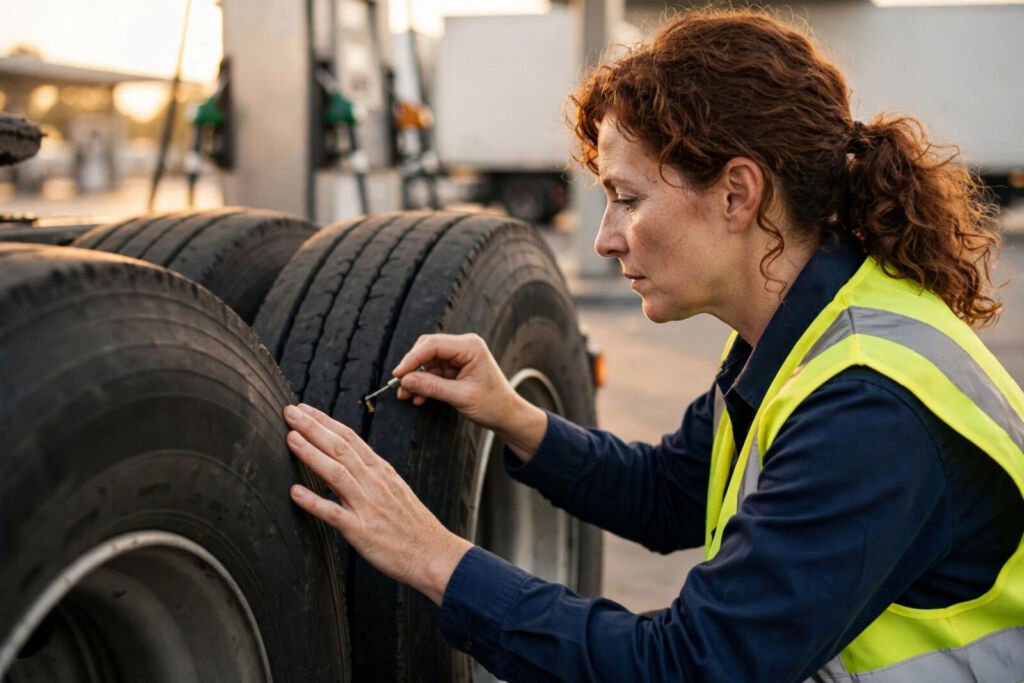
Measure the tread
Front wheels of a truck or truck tractor: at least 4/32 of an inch, measured at any point on a major tread groove. Every other tire: at least 2/32 of an inch in a major tread groove. Don’t measure where tie bars, humps or fillets sit (49 CFR §393.75(b)–(c)). Wear bars show at 2/32 or less (Michelin) — never take a depth reading on the bar.
Duals as a pair
Gauge both tires in every dual pair — the inner one’s pressure cannot be known from the outer one’s look. Keep dual mates within 5 psi of each other and within 1/4 inch in diameter (Michelin); a flat inner dual leaves its mate carrying the pair’s load alone. Check between the duals for debris (Georgia CDL Manual).
Damage and valves
You may not operate on a tire that has ply or belt material exposed through the tread or sidewall, any tread or sidewall separation, is flat or has an audible leak, or has a cut that exposes ply or belt material (§393.75(a)). A bulge, bump or knot evidencing separation fails the inspection standards (49 CFR §570.62(c)). A valve cap keeps debris out of the core and acts as a secondary air seal if the core leaks (Michelin).
The decision
A safety-affecting tire defect goes on the DVIR; defects listed there must be repaired, and the repair certified, before the vehicle is operated again (§396.11(a)(3)). §396.7(b)’s keep-moving exemption covers a vehicle discovered unsafe while being operated on the highway, continued only to the nearest place repairs can safely be made and only if that is less hazardous than staying — it does not authorize starting a new loaded leg on a defect found at a fuel stop. General information only — not legal advice.
Quick checklist
- Gauge every tire, inner duals included.
- Cold (manufacturers): parked 3 hours, driven under a mile. Warm: subtract Table 1 buildup — never bleed.
- Steers at least 4/32, others 2/32 — major groove only; bars are not the steers’ line.
- Duals within 5 psi and 1/4 inch; nothing between them.
- No exposed ply, separation, leak, cut, or bulge.
- Every valve capped — a seal, not a federal requirement; CDL inspection checks caps.
- Fails? Get it inspected by a tire shop. No leg until repaired and certified.
- Independent testing
- No sponsored rankings
- Prices verified November 2026