
Reader-supported: no affiliate links active yet — our rankings can't be bought. How we rank →
Colorado Chain Law on I-70: Carry Them All Season, Chain Up When It Triggers

On this page
It is a clear November morning in Denver and you are dispatched west on I-70. The sky changes nothing. Colorado’s chain season opened on September 1, and the law has two separate duties drivers mix up every year. The first is what rides on your truck. The second is when those chains go on the tires. Get the first wrong and you can be fined on a dry road. Get the second wrong and you are the truck blocking the pass.
First: the chains ride on the truck from September 1 to May 31
Under Colorado’s Must Carry Law, every commercial vehicle with a gross vehicle or combined weight rating of 16,001 pounds or more must carry chains or an approved alternate traction device from September 1 through May 31 — on I-70 west of Morrison (milepost 259) and on six more corridors: Highway 9, U.S. 40, U.S. 50, U.S. 160, U.S. 285 and U.S. 550. The duty holds regardless of the weather. The statute counts a truck as equipped when it uses or carries the right traction gear — in season, carrying is the compliance. What you carry has to match your rig: a straight truck runs with four tire chains or an approved equivalent, and single-drive-axle combinations cannot count tire cables at all. CDOT puts the cost plainly: a $500 fine for not carrying chains, and up to $1,000 plus surcharge if you end up blocking the roadway. The same law also keeps commercial vehicles out of the far left lane through Glenwood Canyon, Dowd Junction, Vail Pass, the tunnel grades, Georgetown Hill and Floyd Hill during the season.
Then: when the signs light up, chain the drive tires
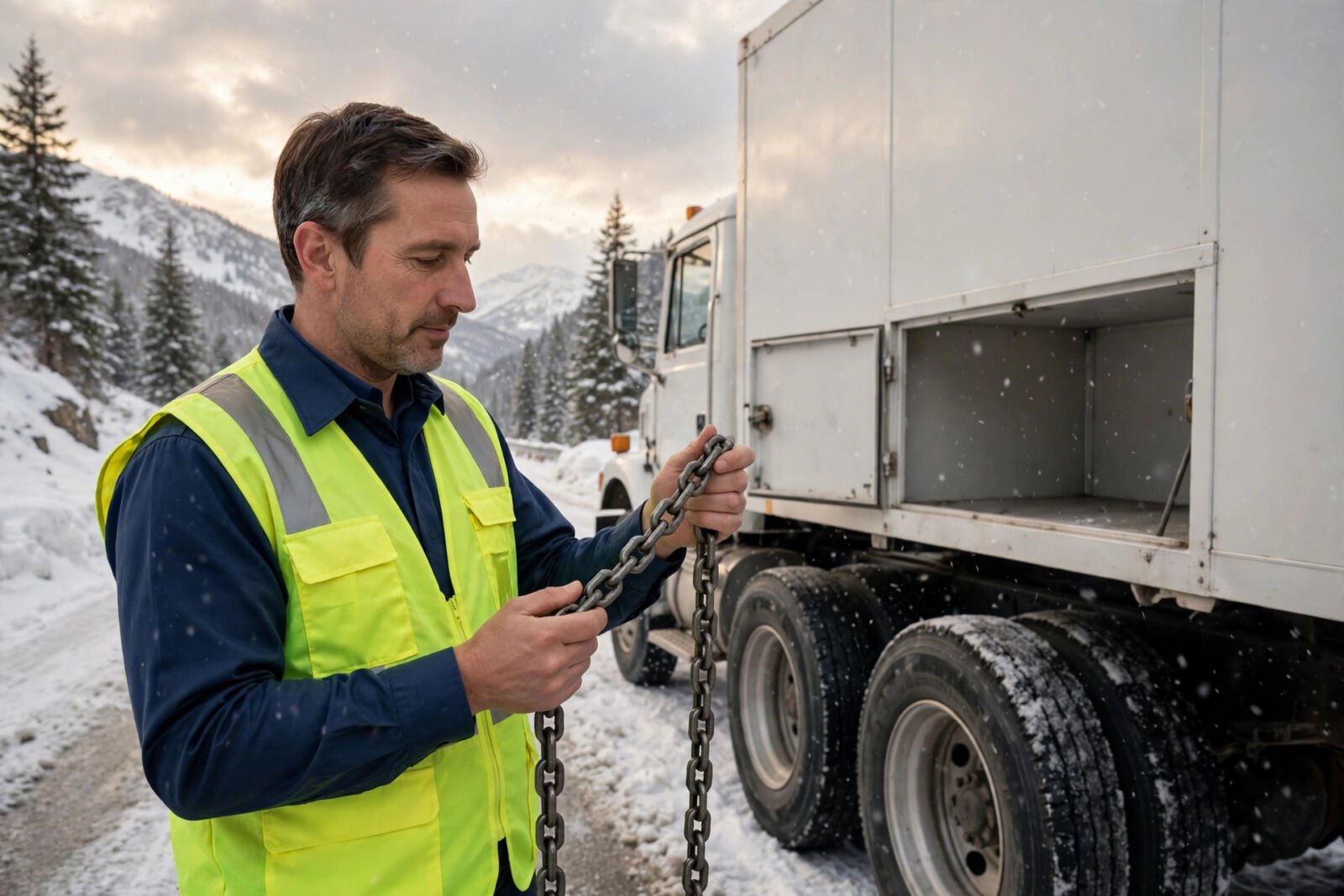
Carrying is not chaining, and the second duty starts when conditions turn. When the highway is icy or snow-packed, CDOT can restrict any state highway, and the restriction is in effect when the signs — including the electronic message boards — are up. From that point it is unlawful to go on without the required equipment, so watch the boards and check COtrip.org before you climb. When the requirement triggers, pull into a chain station — Colorado has 130 designated stations, 22 of them on the I-70 corridor — and chain the drive tires: at least four drive wheel tires on a truck with four or more drive wheels. The trailer tires do not get chained; chains are a drive-axle tool. Do not confuse this with the Passenger Vehicle Chain Law in the same storm warnings — that is the last step for cars before CDOT closes the highway. Your duty is the commercial one: chains carried all season, chains installed the moment the restriction is on.
Quick checklist — carry all season, chain up on the trigger
- September 1 to May 31: chains or an approved traction device on board — every trip over the corridors, clear sky or not.
- Know your corridors: I-70 west of Morrison, plus Highways 9, 40, 50, 160, 285 and 550 in their marked stretches.
- Carry the right count for your configuration — and no cables on a single-drive-axle combination.
- Check COtrip.org and the message boards before the climb; a restriction is live when the signs are up.
- Chain at a station, on at least four drive tires. Trailer tires stay bare.
- No chains on board is a $500 fine — and blocking the road unchained runs to $1,000 plus surcharge.
- Independent testing
- No sponsored rankings
- Prices verified November 2026


